

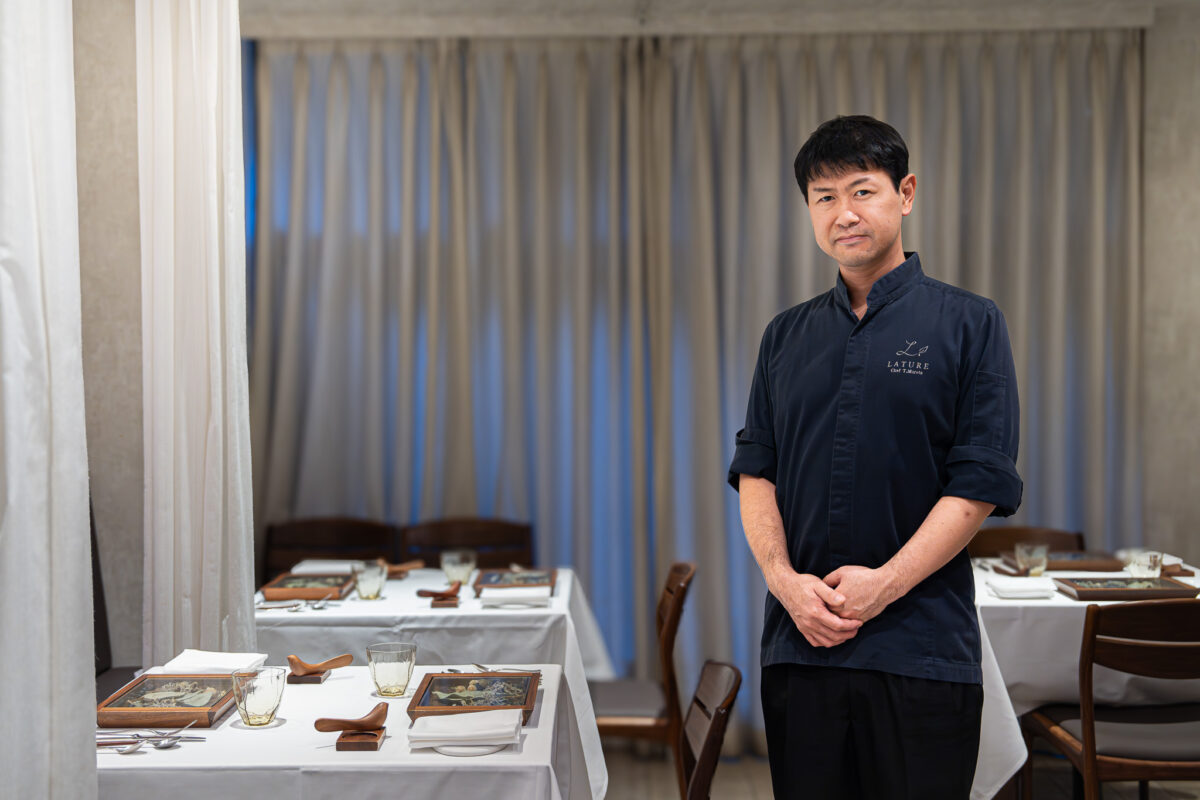
“There are fishermen who believe the mountains have something to do with the declining numbers and smaller sizes of fish. The mountains have grown wild due to damage caused by animals and a lack of management, resulting in fewer nutrients flowing from the mountains to the oceans. There is a link between protecting the mountains and protecting the oceans. As a hunter, I feel I can bring a unique perspective to these issues.”
Chefs for the Blue Member Interviews Vol. 3 features Lature’s Chef Takuto Murota. He has witnessed the changes in the mountains as a hunter who catches his own wild game. He sees how the issues of the mountains and the issues of the oceans are intertwined at the roots. He talked about the role humans must play to maintain a harmonious relationship with nature.
__________________
Ever since Chef Murota obtained his hunting license in 2009, he has made weekly trips to the mountains during hunting season, bearing witness to the changes taking hold.
While global warming has led to a decline in migrating bird numbers, deer, wild boar, and other four-legged animals continue to multiply. Forests and woodlands have been devastated by logging and poor maintenance, and landslides and fallen trees are regular occurrences. Hungry animals eat tree bark, further weakening forests.
“It feels like something very strange is happening to nature.”
Chef Murota talks about how the issues are not isolated to the mountains.
“There are fishermen who believe the mountains have something to do with the declining numbers and smaller sizes of fish. They say that nutrients that typically flow from the mountains through rivers and groundwater to the sea have decreased to the point that plankton—food for small fish—cannot thrive.
The mountains and oceans are linked, and in Japan, especially, very little distance separates them. Everything in nature is a cycle, so changing the oceans requires us to consider the mountains, too.
It’s up to humans at the top of the food chain to restore balance.
I truly believe we have a responsibility to preserve the earth’s resources for the next generation.”
At his restaurant, Chef Murota uses MSC-certified* lobster and seafood shipped directly from fishermen implementing sustainable fishing practices. He visits the fishermen and listens to their stories, only contracting with them after being convinced of their vision and fishing methods.
His menu includes fish caught by single-line fishermen in Tsushima, such as chub mackerel (masaba; Scomber japonicus), red-spotted grouper (kijihata; Epinephelus akaara), and longfinned bullseye (chikamekintoki; Cookeolus japonicus), as well as carp and other freshwater fish raised through aquaculture.
“Dishes featuring carp can also be found in France. When we hear “fish”, we immediately think of the ocean, but Japan also has many freshwater fish varieties. Unlike many farmed saltwater fish, carp can be raised on feed that is mostly plant-based, a significantly lower burden on the environment. It’s not so easy to prepare at home, but we chefs can use techniques to cook up delicious dishes, so I want to make a point of using carp and other fish like that.”
Chef Murota also cooperates with a local extracurricular education group, supporting food education activities for elementary school students.
Declining marine resources, mountain degradation, food loss and waste—if we clearly explain the issues we face in the food industry, children approach them head-on. And if those children have the chance to talk about the issues in their homes, the message reaches their parents’ and families’ hearts, too.
And there’s one more desired outcome—that they may develop an interest in cooking and cuisine.
“At the children’s cafeteria**, we all cook the food together, then sit down to eat. I want them to experience the fun in that. It would be great if even one child from among the participants becomes a chef in the future.”
One of the most serious issues facing the restaurant industry is staff shortages. One key way to increase the number of chefs is to make them more visible; chefs need to leave the kitchen and make active contributions to society, says Chef Murota.
“Chefs for the Blue is also engaged in activities of this kind. If we can raise the social standing of chefs, it will become an occupation children aspire to.
Whatever I do, a key goal is to increase the number of people working in our industry.
No matter how good the ingredients are, without chefs, our food culture will disappear.”
*Marine resources obtained through sustainable fishing practices.
**A social system in Japan (called Kodomo Shokudo) for providing a safe space and nutritious meals for children.