

“Japanese cuisine is governed by conventions like ‘this fish for this season’. But surely that is not the only way.
Breaking free from the fixation with certain fish varieties can be the hook for creating new forms of Japanese cuisine. After all, tradition at any time is created by the people living in that moment.”
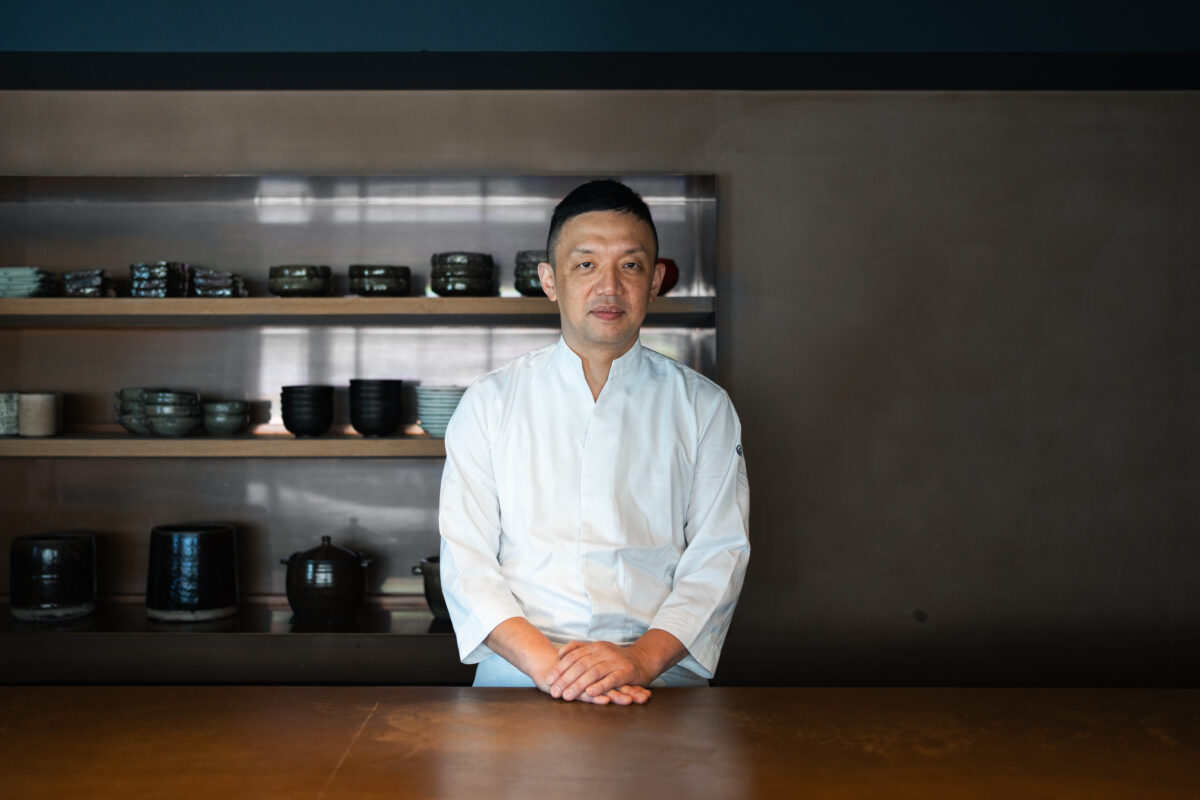
Chefs for the -Blue Member Interviews Vol. 2 features Tenoshima’s Chef Ryohei Hayashi.
Chef Hayashi trained at the long-standing Kyoto restaurant of Japanese cuisine, Kikunoi. He served as the right-hand man to owner/chef Yoshihiro Murata, who was instrumental in securing the designation of washoku as UNESCO Intangible Cultural Heritage. Through his work there, Hayashi shared Japanese cuisine around the world. Upon going independent, he began challenging himself to work with little-known fish varieties deeply rooted in the food cultures of Japan’s local regions. We asked about what led him to this cause.
——————–
During his years at Kikunoi, spreading the charms of Japanese cuisine around the globe, Hayashi began to feel nervous that the roots of Japanese cuisine were unravelling. Lack of staff, depleted resources, and a changing ecosystem—these issues were unfolding across Japan’s primary industries. Hayashi’s sense of crisis grew during his preparations to go independent and conversations with the producers he visited around Japan.
“I was invited to become a member of Chefs for the Blue just as I had resolved to take action, because if we fail to protect our rich natural environment, we cannot pass on Japanese food culture to future generations. I joined without hesitation, wishing to move even one centimeter closer to a brighter future.”
Hayashi cultivated connections from scratch for all his seafood supplies. “The key question for me was whether we envisaged a shared future. We naturally connect with those who hold a shared vision. That’s because we understand we can’t get anywhere unless we work together.
In addition to avoiding spawning and juvenile fish, I do not, in principle, specify fish varieties when I place an order. The broker or fisherman simply selects and sends us whatever is available that day. There’s no point scrambling for a specific popular fish whose stocks are diminishing. It’s better to use fish that are only consumed locally, or that all but the locals have forgotten how to prepare, and to support the fishermen by raising the value of these little-known fish.”
When the restaurant first opened, fish Hayashi had never seen or heard of arrived on a daily basis. Each time, he picked up the phone to learn about the fish and how to prepare and eat it. It’s most unusual to cook a fish for the first time in those few short hours before the restaurant’s doors open each day, but the unknown meant regular new encounters, which Hayashi says he found fascinating.
Japanese cuisine is full of conventions cultivated throughout its long tradition.
“‘This fish for this season’ is one such convention. It’s a truly wonderful culture, but surely that is not the only way.
Cha ni te are, cha ni te nakare is a saying by Soetsu Yanagi, the founder of the Mingei movement celebrating folk craft. His saying, which means “Devoted to tea, but not enslaved by tea”, is a warning that you must not lose sight of the true meaning of tea ceremony because you get caught up in the conventions of it. I believe the same is true for cuisine.
Japan extends far from east to west, and the fish catches vary widely by region, as do the ways of eating them. Japanese cuisine is not only about Kyoto; surely it’s broader than that. The more variety, the better. If you see it as such, there’s nothing at all special about using obscure fish.”
One day, Hayashi took delivery of a sardine variety called hira from a fishmonger operating in the Seto Inland Sea for 125 years. An essential ingredient in a long-established Okayama regional dish called Bara Sushi, the fish’s many small bones led to its disappearance from dining tables unnoticed.
“This fish is absolutely delicious. There are so many possibilities for new forms of Japanese cuisine in the hands of skilled chefs. Traditions have always been made by people living in their “now”. Breaking free from the fixation with certain fish varieties can be a hook for forging new traditions.”
There’s another conviction Hayashi holds dear when it comes to procuring fish. “I pay the said price and never complain about the fish I receive. I also pay the proper price for sample products. We’re all doing our best, so it’s nonsense to complain. It’s up to the fishermen and brokers to set the appropriate prices.”
But what if the price is astronomical? Or the product is completely unusable? “That’s the sign that I’m not a trusted partner.”
Doesn’t it make you nervous to entrust so much to others? “We just have to resolve ourselves to that. It’s the same for all our marine resource issues. Fishermen, brokers, chefs—I believe it’s time for all of us to change our approach. We have to face reality, face ourselves, discard yesterday’s worldview and look to the future. It takes a lot of courage, but we don’t have a choice.”
Hayashi carries with him the words Chef Murata spoke repeatedly during his training days.
Public good—to what extent can we contribute to society through cuisine?
“When I thought about what I would dedicate my life to, Teshijima came to mind.”
Teshijima is a small island in the Seto Inland Sea, part of Marugame City in Kagawa Prefecture. It’s the location of Hayashi’s family home, and where he spends the Obon Buddhist festival period in summer every year. With a long history and a population of 1000 islanders at its peak, Teshjima suffered after the decline of the coastal shipping trade and is now an isolated rural hamlet of just 16 people, mostly over 65 years old. Here, Hayashi is spearheading a project to construct accommodation facilities.
“It’s a microcosm of Japan. That’s precisely why I want to build accommodation here. It should trigger all kinds of employment toward my goal of restoring self-sufficiency. Ultimately, if we can create the structures for generating profit on the island, it can serve as a model case for what we can achieve across Japan.”
If you gather a circle of partners and initiate social action, even a grandiose goal that everyone says is impossible can come true someday.
Having followed and admired Chef Murata all these years, Chef Hayashi knows, “It’s the sincere, steadfast ideas that can truly transform society.”